Friday, November 15, 2013

Flashback Friday: Thor (Branagh, 2011)

When Marvel Studios was deciding which superheroes to use in their Avengers Project, they needed a group that was recognizable yet able to cohesively fit in one movie. Iron Man was a billionaire with an advanced cybersuit, The Incredible Hulk was a scientist who was exposed to a tad too much Gamma radiation, and Captain America was an ultra-strong product of the Super Soldier experiments. The last member? A Norse God who can literally control thunderstorms. The creative team at Marvel had to figure out a way they could integrate this alien into the Avengers line-up without being hokey. So, they hired one of Shakespearean cinema's finest directors and a cast of hugely talented actors to bring the God of Thunder to the big screen. It's sequel is in theaters now, so if you're planning on seeing it this weekend, or still in the mood after already viewing it, this post is for you. Today on Flashback Friday, we're hanging out with Thor.


Stan Lee is the creator of most of the recognizable Marvel brands. He worked on X-Men, Spider-Man, and the Avengers in their earliest days. Stan Lee created Thor because he was interested in God-like superhero, and found that many people were unfamiliar with Norse mythology. So, he crafted a new Marvel world, where science and magic exist as one and Gods roam the galaxy as almighty aliens. Thor soon became one of Marvel's most popular incarnations. 

After the success of Iron Man, Marvel's newfound cinematic universe was green-lighted to continue development. The Incredible Hulk rode it's waves, and Iron Man 2 proved an equal triumph. Thor was selected as the next film, and in 2011 premiered alongside Captain America: The First Avenger later that summer. 

Because of it's epic proportions and deep mythology, Marvel wanted to hire a capable filmmaker to helm the project. Kenneth Branagh, who was eager to branch into action franchises, accepted the offer and immediately got to work. The actors and crew loved working with him, and felt that he brought cinematic innovation to a film that may have otherwise been emotionally stalled.

The movie is the origin story of Thor, who's father Odin united the Nine Realms and rules over them as king. The God of Thunder is next in line for the throne, but his coronation is halted by a group of Ice Giant thieves. Furious over their entrance, Thor leads a small fellowship of warriors, including his four best friends and his brother Loki, to the Ice Giant homeworld to strike fear into their kind. The Ice Giants retaliate with further bloodshed, and Thor's group is narrowly saved by Odin and gatekeeper Heimdall. Angered by his son's brash arrogance and child-like behavior, Odin banishes Thor to Earth to live as a mortal.

On Earth, Thor meets with Jane Foster, a scientist who is studying the pathways Thor's people use to travel between worlds. Jane, along with mentor Erik Selvig and intern Darcy, work with the hero to try and return him home. However, they may have more trouble than they bargained for when Thor's mischievous brother Loki begins causing havoc of his own. 

For the title role, Chris Hemsworth was selected based on a great screen test in which he made up a huge backstory for the character. He looks at acts like Thor, brining both the physical and emotional depth needed to portray him. Hemsworth is also quite hillarious, and his narcism comes across as comical rather than annoying, as so many protagonists are. 

Natalie Portman is a beautiful love interest, and although she mumbles through most of the science-y jargon, she remains a likable lead. Anthony Hopkins proves he can sink his teeth into any role, and as Odin is the perfect leader, a capable warrior, and a stern yet loving father all at the same time. It's an awesome, awesome role that is thrilling to watch. 

After seeing The Avengers, Tom Hiddleston's Loki is just silly in Thor, and provides only a minor threat; nevertheless, Hiddleston's first foray into the part is a good one. Clark Gregg's Agent Coulson is hilarious as usual, and Kat Jenning's Darcy is excellent comic relief, too.

The production design includes a beautiful Asgardian landscape, shining with a radiance and architectural brilliance that is almost unthinkable. The Ice Giant's homeworld is equally well made, as is the New Mexico towns on Earth. Thor's hammer has a lot of small intricacies, such as latin speech an Odin's symbol. The designers also made the hero's costume more realistic and less intricate than the comics, though Loki's villainous garb is almost exactly like the original. 

Thor remains a unique superhero adventure because it's almost Shakespearean in quality, with a royal family dispute having galactic consequences, and themes of arrogance, jealousy, love, and loyalty. It is extremely well crafted, and features arguably the best overall ensemble of the Marvel lineup (except for The Avengers, of course). It takes a great team to make Norse mythology fit in a semi-realistic setting, and Branagh and company do it wonderfully. Thor is a fun action film with lots of thrills, funny moments, and a ton of heart. 

"Whosoever holds this hammer, if he be worthy, shall possess the power of Thor!" 


Tuesday, November 12, 2013

The Counselor (Scott, 2013)


Oscar-winning director Ridley Scott. Oscar-winners Javier Bardem and Penelope Cruz. Global superstars Michael Fassbender, Cameron Diaz, and Brad Pitt. The writer behind The Road and No Country for Old Men.

It seems like The Counselor should have been a sure thing.

Unfortunately, it is a garbled mess of a thriller, bogged down with uninteresting characters and a shamefully boring story. The film goes nowhere, and at no great speed.

The talents behind The Counselor are geniuses in their craft, but that does not stop the movie from failing at nearly every angle. Cormac McCarthy's ludicrous dialogue, filled with mediocre monologues and a few too many backstories, does not come through with any real effect or emotion.

Michael Fassbender stars as a man simply known as The Counselor, who is currently juggling a new fiancé (Penelope Cruz), a handful of lackluster clients, and his new trade: dabbling in the drug industry, along the help of his associate (Javier Bardem), and a drug expert (Brad Pitt). Bardem's girlfriend (Cameron Diaz) begins to cause problems, however, which propels everyone into a survival-of-the-fittest death race.

The fine actors in this production seem to have no interest in The Counselor. They give little effort to the dialogue, have no chemistry with one another, and act as though they do not even want to be there. Even the costuming is ridiculous; Bardem's design and character is meant to be eccentric, but the Oscar-winner himself just reads his lines and follows the motions with lackluster avail.

Diaz has received some flack for her femme fatale performance, and she does stick out like a sore thumb. However, this remains a good thing throughout the story; her villainous role is so looney it's almost enjoyable. She's certainly better than co-star Cruz, who does nothing but complain and spew petty garble.

The screenplay is thinly written, and the story is clearly progressing in a script-based manner. Ridley Scott's lack of directorial innovation comes across as lazy filmmaking, uncharacteristic of the legendary director. Everything about The Counselor is cheap. 

And what the heck was with the cheetahs? Were they meant to represent the primal instincts of the characters? To show how humans are selfish creatures concerned solely for their own predator-like survival? Please. They're just cool to look at.

The Counselor remains proof that it takes more than a beautiful cast and an Oscar-worthy crew to make a good picture. It's one of the more forgettable movies of 2013, and the ending will leave viewers shrugging their shoulders. Just YouTube some of the more "interesting" death scenes, and that can be the extent of your suffering through the film.

One out of five stars. 

Sunday, November 3, 2013

Ender's Game (Hood, 2013)


Science fiction meets coming-of-age meets highly ethical questions. Sound like Star Wars? Well, in the book world, it might as well be. 

Ender's Game, the highly anticipated adaptation of the novel of the same name, is an exciting sci-fi thrill ride, boasted by galactic special effects and fascinating moral quandaries. It features a well-cast ensemble of characters that wonderfully touch every point on the ethical spectrum. 

Asa Butterfield, the successful young actor behind Hugo and The Boy in the Striped Pajamas, plays Ender Wiggin, a "third" who is training to be in the elite children's military. He has great potential, with the intelligence and strength to match even the most respected officers. However, he is psychologically tormented by the mistakes of his older brother, and the pressure of saving the human race. 

In the world of Ender's Game, Earth was attacked by an alien invasion, which nearly decimated the population, and only stopped because of the sacrifice of one brave soldier. Now, as Earth's last line of defense, the people have placed their faith in the children, who's future actions hold the key to humanity's survival. Ender is one of those special progenies, and is selected to join the competitive Battle School. There, he faces not only his fellow classmates, but is own personal demons. 

Harrison Ford finally returns to sci-fi as Colonel Graff, the commander of the Battle School who has the ultimate confidence in Ender's potential. Viola Davis beautifully plays his counterpart, Major Anderson, who is a little more conscious of Ender's troubles. Hailee Steinfeld, Abigail Breslin, and Moises Arias round out the cast as Ender's classmates and family. 

The visual effects allow the viewer to delve deeply into the story line, immersing them in this rich and colorful universe. The costumes and sets are well made, and there is a haunting and foreboding familiarity to the whole space stations. The infamous Battle Room is perfectly articulated and designed, and the action in there does not seem choreographed or fake. Ender's world is a really cool place to play. 

As I have stated numerous times before, my personal belief is that a movie should be judged on it's own merits, and not on the book for which it is based on. They are two completely different entities, and should be critiqued as thus. For future reference, this will be my final comparison of book-to-screen on this website. 

Ender's Game follows the novel rather well, with only a few obvious removals and changes. The book focuses more on the relationship between Ender and his siblings, but this would detract from the film's values and point of view. A lot of the story is condensed, but the necessary portions are kept intact. 

The film is also famous for it's curious moral dilemmas: should children be under so much pressure to save Earth? Is Col. Graff pushing Ender too far? Will Ender be forever damaged by his training? There are some very interesting ethical issues presented in the movie, sure to inspire discussion for hours after watching. 

Ender's Game remains supremely exciting throughout, never slowing down or reaching a standstill. The actors are in top form, and the action scenes are loads of fun. Science fiction is the stuff of dreams: they allow us to create new worlds, and question the very issues that plague us today. It's a genre that really benefits when seen on the big screen, and Ender's Game is a welcome inclusion to that group. 

Four and a half out of five stars. 

Friday, November 1, 2013

Flashback Friday: Hugo (Scorsese, 2011)

Martin Scorsese directing a family movie seems like an odd idea. After all, how could the filmmaker behind Goodfellas, Gangs of New York, and The Departed create a moviegoing experience suitable for children? But after watching his first attempt at the genre, it is very clear why he was chosen- the film is an adoring love letter to silent cinema. And who better to direct this passion project than Marty, who is a world-renowed expert on film history? Based on the Caldecott-winning novel, this movie proved that 3-D and emotional drama can blend seamlessly together. With stars Asa Butterfield and Ben Kingsley reuniting for another highly anticipated book-to-screen adaptation, Ender's Game, released today, Movie Critic's Club is taking a short look back at one of 2011's standout pictures. Today on Flashback Friday, we're going on a film-loving adventure with Hugo


The Invention of Hugo Cabret made history in 2008 by being the first novel to ever win the Caldecott Medal, which is usually reserved for picture books. But Brian Selznick's Hugo Cabret is not like any other novel- on every other page is striking animation, nearly doubling the book's size but significantly adding to its imagination. 

Almost immediately after the book's publication, Martin Scorsese bought the film rights, hiring the talented John Logan (The Aviator, Gladiator) to adapt the screenplay. Hugo is the first movie Scorsese filmed in 3-D, and his first movie not shot on film. He was curious about the technology, and was eager to make his own contribution to the technique. It had, in recent years, received a revival- but no three-dimensional picture had matched the depth of 2009's Avatar

Despite a lukewarm box office draw, Hugo was critically acclaimed, landing on several year-end "Best Of" lists for it's strong depiction of the magic of the movies. It became an awards darling, earning the most Oscar nominations (11) for the 84th Academy Awards, including those for Best Picture and Best Director. Eventually, it tied with Best Picture-winner The Artist for most wins (5). 

Asa Butterfield plays the titular character, with the same emotional baggage he brought to The Boy in the Striped Pajamas (2008). Hugo Cabret is an orphan who lives in a train station, repairing the building's clocks so that inspectors won't find him. He was extremely close with his father (Jude Law), but after his dad dies in a horrible fire, Hugo is left alone and bewildered. His sense of wonder, however, was not damaged, and the child becomes obsessed with repairing a mechanical automaton that he and his father were working on before his death. 

Hugo encounters a group of eccentric characters in the station, played by several successful actors like Emily Mortimer, Richard Griffiths, and Christopher Lee, who shines as the station's kind librarian. Hugo, meanwhile, avoids an obsessive Inspector (Sacha Baron Cohen). Chloe Grace Moretz of Kick-Ass fame co-stars as a lonely girl eager for adventure, who fatefully encounters Hugo and sets out to solve the mystery of the automaton along with him. 

(WARNING: Spoilers throughout the next few paragraphs. Part of the mystery of Hugo is revealed here, so you may want to watch it first before reading the next two paragraphs. Spoilers end with the paragraph that starts with "The CGI is remarkably effective...".) 

Ben Kingsley wonderfully portrays George Milles, a silent film director and highly influential moviemaker from the 1930's. He made over 500 films in his lifetime, but all the footage was lost after World War II, and only a few pictures remain. Best known for his Voyage to the Moon (drawn by the automaton), Milles disappeared for years before receiving a public revival in the latter years of his life. Kingsley's depiction of him in the film is mostly true, despite some minor dramatic changes (Milles actually had two wives, the first of which was the movie star, not like the one in Hugo; plus, Cabret is a fictional character, and Milles managed to bring himself into the limelight). 

Part of the magic of Hugo comes from Scorsese's stark dedication to the preservation of Mille's memory. He features many short films, shot by Milles himself, throughout the story. Plus, there are numerous allusions to other cinematic milestones- the hilarious clock tower theater scene from Safety Last!, as well as various early movies and audience reactions.   

The CGI is remarkably effective, bringing an early 20th century train station in Paris to glorious life. The screenplay packs an emotional wallop, and viewers will find themselves falling in love with Hugo's story and pure innocence. The costuming, special effects, and sound work rather well, and there are several moments of awe-inspiring movie magic. 

But at its heart, Hugo is a coming-of-age adventure that provides a fun history lesson in early filmmaking. Through various allusions and a sympathetic protagonist, Martin Scorsese proves he was the right man to bring this motion picture to life. In some ways, like Roger Ebert said, this was the mob director's most personal project: filled with a passion for the movies, Hugo radiates with an adoring love of cinema. And for us film lovers, there's no greater treat than that. 


Sunday, October 27, 2013

Last Vegas (Turteltaub, 2013)


There are only four reasons to see Last Vegas: Robert De Niro, Michael Douglas, Morgan Freeman, and Kevin Kline. 

With all the people that are necessary to make a movie, sometimes it comes down to the actors to determine how good a film really is. In the case of Last Vegas, at best decent direction comes through as entertaining comedy when the stars take center stage. 

Michael Douglas leads the cast as Billy, a wealthy businessman who finally decides to settle down and get married... to a woman nearly half his age. He calls up his three childhood best friends, Paddy (De Niro), Archie (Freeman), and Sam (Kline), who are living at various locations across the country. The friends decide to hold a bachelor party for Billy in Las Vegas, to take a break from their now monotonous lives. 

In Vegas, the guys meet Diana (Mary Steenburgen, who manages to hold her own against four powerhouse performers), a lounge singer who helps the men loosen up and enjoy the city. Health problems and a lack of connection with the younger Vegas crowd causes hilarity to ensue. But soon, jealousy and a long-standing feud between Billy and Paddy could cause the four guys their friendship. 

The movie itself is clichĂ©d storytelling, with a minimalistic effort done on the part of the production team. Fortunately, Last Vegas succeeds thanks to it's four charismatic lead performers, arguably the best male actors in the motion picture industry today. Their chemistry is undeniably addictive to watch. 

Michael Douglas plays his usual charming businessman, and manages to wrangle the most effective drama in the story. Kevin Kline steals every scene he is in, and he has the best lines of the film. The comedic performance evokes his glory days of A Fish Called Wanda and The Big Chill. Morgan Freeman's family subplot is uninteresting and done before; but he, like Kline, nails his dialogue, and seems to be having the most fun of the leading cast.  

Robert De Niro feels out of place, and is the "one of these things is not like the other" factor in the film. Nevertheless, he plays his usual character: a tough-as-nails paternal figure who harasses his friends, but in the end is passionately loyal, and the one you want watching your back. His participation in Last Vegas is certainly not the worst comedic decision the actor has made either (Little Fockers, anyone?).

Kudos to the casting department, by the way, who managed to find four young actors that completely look and act like the four leads for the film's opening credits. 

The comedy is good, better than the average modern farce. It jokes on getting older in an affable way, and puts the characters in some truly hillarious situations. This is both fun to watch and easy to relate to, no matter how old the viewer is. The best work done by director Jon Turtetaub in the movie is the frequent phone conversations, which are nicely edited to create a standout comic effect. Again, not to beat a dead horse, but this is mostly due to the stars. 

Last Vegas frequently dabbles in murky subjects, most of which could have been removed with little to no impact. Themes such as aging, loyalty, love, and death are heavily emphasized with lackluster energy. There are several slow scenes that bog down the picture; however, the scenes with the four stars are highly entertaining, and they go on fun misadventures that will make viewers laugh hysterically.

Ultimately, your appreciation for Last Vegas will come from how much you like the four stars. If you don't, then the movie is a slightly better-than-average comedy that may or may not make you laugh. If you do, on the other hand, then Last Vegas is a special treat that will provide escapist entertainment for a little under two hours. 

Three out of five stars. 

Friday, October 25, 2013

Flashback Friday: The Rocky Horror Picture Show (Sharman, 1975)

Let's do the time warp, shall we?

Most movies that bomb fade away after a short time. Once in a full moon, however, the perfect audience combines with the right film to create something truly magical. Even if that magic involves rice, toast, water, newspapers, playing cards, costumes, and a live cast singing along with the show. It's the midnight movie that arguably has the largest single-movie cult following of all time. For after all, it's just a jump to the left, then a step to the right. Put your hands on your hips and lock you knees tight. You do the pelvic thrust, it really drives you insane. Let's do the time warp again today on Flashback Friday's look at The Rocky Horror Picture Show.


No, this movie is not a critical masterpiece, in any stretch of the imagination. But in terms of pure theater enjoyment, pure longevity, and pure madness, there's hardly a film like it. It's an acid-trip of a plot, nightmarish yet thoroughly enjoyable. From the crazy songs to trippy story-lines, you will have more fun watching and participating in The Rocky Horror Picture Show than any other horror-fest this Halloween. There's a reason 20th Century Fox has kept it in limited release for almost 40 years... longer than any movie in the history of cinema.

Director Jim Sharman had no idea the sensation he was making, a film based on the successful stage musical The Rocky Horror Show. Richard O'Brien, the brainchild of the theater production, helped Sharman to write and develop the feature length adaptation.

The movie follows Brad Majors ("ASSHOLE!") and ("Dammit") Janet, a couple who get lost on their way home from a wedding. They make their way to a mysterious castle, the home of Dr. Frank N. Furter (Tim Curry). But the couple quickly learns that this is no ordinary castle, and after a dance rendition of "The Time Warp", find themselves coming face-to-face with the "sweet, sweet transvestite" himself.

It was the film debut of Tim Curry, who played the iconic Dr. Frank N. Furter on Broadway and in the motion picture. Curry was highly involved in crafting the character, and played him throughout several productions of The Rocky Horror Show all over the world. His appearance in the movie made him an international celebrity and cult icon.

Brad Majors is played by Barry Bostwick, best known for this and his role as the Mayor on the '90's television sitcom Spin City. Janet is played by none other than Academy Award-winner Susan Sarandon, thrust into the world of the bizarre. Charles Gray (best known for playing Ernst Stavro Blofeld in Diamonds are Forever) plays the narrating criminologist, Meatloaf cameos as "the ex-delivery boy" Eddie, and Richard O'Brien rounds off the main cast as the Igor-like Riff Raff.

As a glorious tribute to B-rated science fiction and horror cinema, the movie's castle setting is reminiscent to the mise en scene of Hammer Horror films (movies about monsters like Frankenstein and Dracula, and frequently starred the likes of Peter Cushing and Christopher Lee). The style of these movies are different than, say, Universal Horror, but their gothic interpretations inspired The Rocky Horror Picture Show's plot and setting.

As shocking as it may seem, a movie that featured transvestites, dance numbers, and Meatloaf did not do well in theaters during it's initial run. Halloween theater runs in 1975 were cancelled after it became a commercial bomb in the locations it did open at. Distributer 20th Century Fox even tried to release it for cheap at colleges for a double feature, but it flopped there as well.

Then, as if almost instantly, the movie had midnight performances in New York City throughout April 1976, and eventually many of the same patrons kept returning to see the show again. As this developed, audience members began shouting at the screen, talking back to characters and singing/dancing alongside them. By Halloween of 1976, people arrived at The Rocky Horror Picture Show in costume, and within two years it became a national midnight sensation.

Critics have always looked favorably on the film, with nearly unanimous praise for Curry. However, many agree that the film needs to be seen on a big screen with audience participation to truly appreciated as a cultural icon. Seeing the film by itself is kind of weird, and almost laughably bad.

The midnight shows continue to this day, with each theater having a unique set of shouts, props, costumes, and interactions. Oftentimes, a shadow cast mirrors the movie onstage. No experience is doubled from theater to theater- a very rare feat when it comes to movies. Seeing it annually under these conditions makes for a wonderful perk, and people have been watching this film for the past forty years. It's a part of their Halloween tradition as much as watching It's a Wonderful Life at Christmastime.

The words "cult following", "midnight showings", and The Rocky Horror Picture Show are synonymous. It's a Halloween experience not to be missed. So find a local theater playing it, buy tickets, dress up in drag, and check it out.

And in case you don't know it:


Friday, October 18, 2013

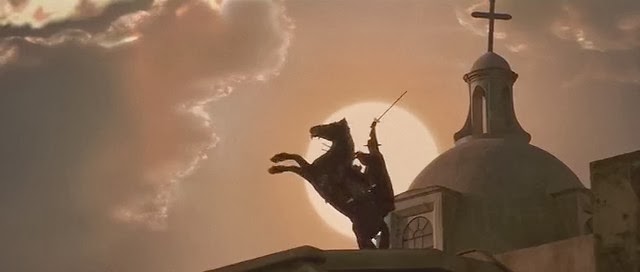
Flashback Friday: The Mask of Zorro (Campbell, 1998)

Robin Hood. Django. The Lone Ranger. These are just a handful cinematic heroes who have appeared in a multitude of films and sequels, oftentimes having very little to do with one another (besides the central hero himself). These movies, popular in the 1940's and 50's, brought repeated heroes that captivated audiences back to the big screen. Another popular hero was the character of Zorro, a Californian vigilante who protected the people and fought against the corrupt Spanish who ruled over them. In the late 1990's, the character of Zorro returned to the movies, in the form of a man who would become one of Spain's most prominent actors. It eventually became one of the best swashbucklers in the better part of two decades. Today on Flashback Friday, we're putting on The Mask of Zorro.


The character of Zorro was created by pulp writer Johnston McCulley in 1919, and since then has become a staple of film, television, comic books, and novels. Much like Batman and Robin Hood, he fights for the greater good, the poor who otherwise cannot defend themselves. His secret identity is Don Diego De La Vega, a Spanish nobleman living in California. In The Mask of Zorro, Don Diego is played by Anthony Hopkins, who had long desired to star in an action flick. The role was originally written for Sean Connery, who after months of stalled development had to leave the project.

The Mask of Zorro had a troubled start, with Steven Spielberg initially spurring interest in the idea in 1992. After the script was written, the film was passed along to several directors who all dropped out to pursue more stable pictures. Robert Rodriguez, the at-the-time much discussed director "cheap" movies, was eventually hired in 1995 due to his ability to work under a tight production budget. He brought Antonio Banderas, the star of his own El Mariachi and Desperado, to play the titular character.

However, when Rodriguez refused to budge on lowering the budget, TriStar asked him to leave. With Banderas still attached to star, the studio turned to Martin Campbell to direct. Campbell was fresh off his success on the James Bond film Goldeneye, and he agreed to direct The Mask of Zorro instead of the next Bond movie, Tomorrow Never Dies.

The Mask of Zorro furthers the tale of Don Diego De La Vera (Anthony Hopkins), who at the beginning of the picture decides to retire from his life of heroism, and settle down with his wife and baby daughter. However, a series of events leads to his imprisonment, and bent on seeking revenge against the corrupt Don Rafael Montero (Stuart Wilson).

Years later, Alejandro Murrieta (Antonio Banderas) and his brother live their lives as successful thieves, but during one botched heist Captain Harrison Love (Matt Letscher) ambushes and kills Alejandro's brother. Fueled with rage and eager for revenge, Alejandro comes across the path of Don Diego, who soon identifies himself as the hero once known as Zorro. Don Diego agrees to train Alejandro to be the next Zorro, so that each may exact their destinies.

Meanwhile, a beautiful woman named Elena (Catherine Zeta-Jones) captures the eye of Alejandro. Zeta-Jones was introduced to American audiences in The Mask of Zorro, and quickly earned her title as one of the world's most beautiful women. She is greatly talented as an actress, able to integrate heavy dramatic emotion, comedy, and physical prowess into her performance. She herself credits this movie as her breakthrough film.

Martin Campbell again proves himself as a capable action film director, because he can combine emotion with the action. The sword fights and horse chases are a ton of fun. The drama scenes are just as amusing, with lots of humorous dialogue and situations, as well as touch of heart, too. In fact, the party scene may just be the best part of the movie. But above all else, this is an action flick, and in that regard it doesn't fail.

The Mask of Zorro works because it is a mindless swashbuckler, yet has a fairly decent plot. It's highly entertaining to watch, despite the near two-and-a-half hour runtime. Some '90's touches none-withstanding (the hero emerging from the fog in the first frame, and slicing the iconic "Z" into the screen; the subdued sexuality; lots of largely unnecessary explosions; the "poppy" end credits love song), the film is a lot of fun.

So, pick up your sword, fire up your Netflix Instant queue, and get ready to have some good old-fashioned fun.